So, you’ve decided you’re ready to start trying for a baby? Congratulations – I love that for you! But before you lace up those proverbial sneakers and sprint toward the finish line, let’s talk about what it really takes to get there. Spoiler alert: Preparing for pregnancy is a lot like training for a marathon. You wouldn’t expect to run an ultramarathon without some serious prep work, right? The same goes for growing a tiny human from scratch.
Just like with a marathon, you would give yourself adequate time to make all of the changes that are needed to get yourself across the finish line in good time and without injuries. In this pre-race preparation time, you would focus on a training schedule to increase your fitness and stamina to meet the demands of the event, change up your diet to make sure that you are fuelling your body effectively, rest adequately to aid your body’s recovery in between training sessions, warm-up and stretch to prevent injury, etc. When you are trying to conceive (TTC), this preparation phase is called the preconception phase.
How long do you have to prepare for?
Well to answer that, we need to look at the needs of the building blocks of pregnancy – the egg and sperm – and the time that they need to get ready for the big event.
For women, the process that transforms the egg from a tiny immature follicle to a mature follicle, ready for ovulation is called folliculogenesis. Folliculogenesis is a lengthy process that starts roughly 12 months before ovulation occurs with the last 90 days being the time of ramped-up egg growth and development. During this time, everything that the egg is exposed to – good or bad, healthy or unhealthy – can affect how it turns out.
Likewise, in men, sperm goes through a maturation process called spermatogenesis which takes around 74 days before the sperm is mature and ready for fertilisation. As with the egg, everything that the sperm is exposed to can affect its quality.
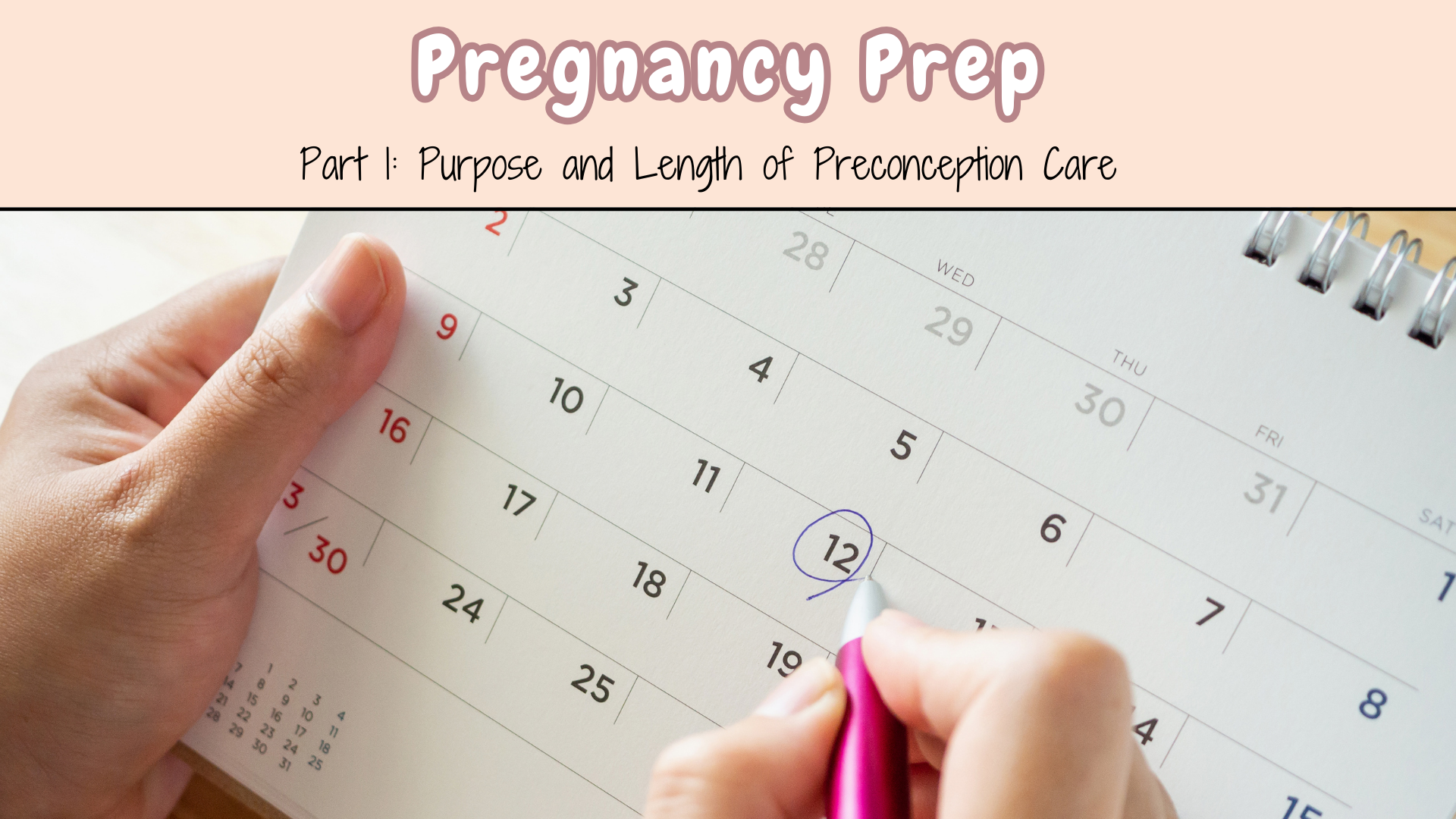
So if you are giving yourself a timeframe to start preparing for pregnancy, a safe bet is to start making all of the changes at least 3 months before actively trying to conceive. Pregnancy is divided into 3 month intervals called trimesters, so this 3 month interval leading up to conception (where preconception prep has the biggest influence) is often called the preparation trimester or pre-mester.
What is the purpose of preconception care?
Preconception care not only helps ensure our little darlings—eggs and sperm—are of the highest quality, but there’s another crucial part of the pregnancy equation that benefits from these healthy changes: the overall health of the mom-to-be.
Once the egg and sperm meet and join to form an embryo, it needs a healthy, receptive uterus to implant into. Preconception care is just as important to get the mom-to-be into the best “shape” possible to sustain a pregnancy and allow that new little life to thrive. The health status of the mother not only will determine if the pregnancy can be sustained or not but it also affects the gene-expression of the foetus through a phenomenon called epigenetics.
Epi-What????
Epigenetics is a collection of processes that affect how a baby’s genes are expressed, based on environmental factors and maternal health. These epigenetic changes can affect everything from the growth of the baby to its susceptibility to diseases.
In conclusion, understanding the timelines for preconception care is essential to give your body the best possible foundation for getting and staying pregnant. Whether you’re preparing for natural conception or assisted reproductive techniques, taking the time to focus on your health in the months leading up to pregnancy can significantly impact your fertility and the health of your future baby. By planning ahead, you give yourself the space to make all the changes to optimize your chances of success.
In Part 2 of our Prepping for pregnancy series, we’ll dive deeper into what habits to adopt in order to nurture your fertility in the preconception phase. From diet and exercise to supplements and sleep habits, we’ll explore simple but effective strategies to help you create a body that’s baby-ready.
If you found this information helpful, and want more like it, subscribe to my email list where you will receive weekly fertility health and wellness tips to sky-rocket your fertile potential and make the journey to parenthood a little smoother.